Growing up in a small town with a rich history, I dreamed of being a historian and pursued the stories of the past indiscriminately. The more I learned about the patterns of history, the more the current problems of the present made sense. My earliest conception of politics was informed by this childhood obsession: I saw politics as a battleground to determine not only a clear view of what had happened but for how we should chart our way into the future.
Over a stretch of years, my interest in the possibility of politics intensified. In the summer of 2004, I vaguely recall tuning into the Democratic National Convention. In accordance with that year’s nominee, the convention was nothing special. The keynote speaker, however, caught my attention. Those watching that speech saw a star being born in the nebula of a politics of hope. Later that year, I saw the news covering that same keynote speaker swearing into the Senate. Reabsorbing his funky full name in the post-9-11 world, I silently wished him good fortune.
A year later, I stood on the left side of my 8th grade English class arguing against the Iraq War. Our class had selected the topic for a debate. I don’t remember how I arrived at that position; if I had to guess, it had to do with some combination of my limited study of world history and the initial growth spurt of my skepticism towards authority.
My 8th grade English teacher was “refereeing” the debate. From the corner of the room, with its George W. Bush 3/4 life-size cardboard cut-out, my teacher placed his thumbs on the scale of the debate by feeding the twenty students in favor of the war information from his computer desktop. I labored against the war alone on the other side, save the class contrarian who occasionally chimed in. Predictably, he did more damage than good.
To my surprise, towards the end of the class period, one of my classmates walked from the cluster of desks on the right side of the classroom to the cluster of desks on the left side. I had, miraculously, changed her mind. Perhaps more likely, she was no longer convinced by her own camp’s position. Seeing someone cross that twenty feet of distance — what may as well have been a Grand Canyon of the mind — was electrifying. In that moment, I caught the bug of politics.
A few years later, that keynote speaker ran for president. At 16 during the Democratic primaries and 17 during the general election, I couldn’t vote yet. But I could volunteer. So, I found myself canvasing for someone who I thought offered something valuable to the Herculean task of politics. I was there at Barack Obama’s final campaign rally in Virginia; a sense of possibility warmed the cold Manassas air and I absorbed every bit of it that I could. Obama took my county, my state, and my country in a historic victory. Anything and everything felt possible.
Four years later, I organized in Pittsburgh for his reelection amidst a busy year in college. The hopes that many projected onto Obama had lost their shine. Still, I saw in him a dogged, pragmatic idealism that mirrored something inside me. In defense of that pragmatic idealism, I organized other volunteers and took to the diverse streets of the city, making the case one person at a time. Obama’s coalition held against a growing discontent. His reelection affirmed my belief that a politics of hope was not only possible but strategic and strong.
Donald Trump’s election strikes directly at the foundations of this belief. However, my commitment to a politics of hope isn’t shaken. To our country’s detriment, I did not see a robust advocacy for and defense of a politics of hope in 2016. Even as we enter the Age of Trump, my gratitude for growing up in the Age of Obama has only deepened. Eight years of a president who held a difficult office with grace, intelligence, and resolve was a tremendous gift to my budding mind.
That’s not to say that there haven’t been moments where Obama strayed from his own promise. Like any individual with such an outsized public influence, Obama is larger than life. His myth is often disconnected from his reality. Still, in that collective myth lies an instructive ideal.
I recently read Cormac McCarthy’s The Road cover to cover during a long day of travel. Set in a post-apocalyptic wasteland, the story is a brutal journey to the depths of despair. Despite its gloomy arc, I found that The Road offered a grand stage for the light of hope. In an essential exchange, the father and son illuminate the vast beacons of hope:
We’re going to be okay, arent we Papa?
Yes. We are.
And nothing bad is going to happen to us.
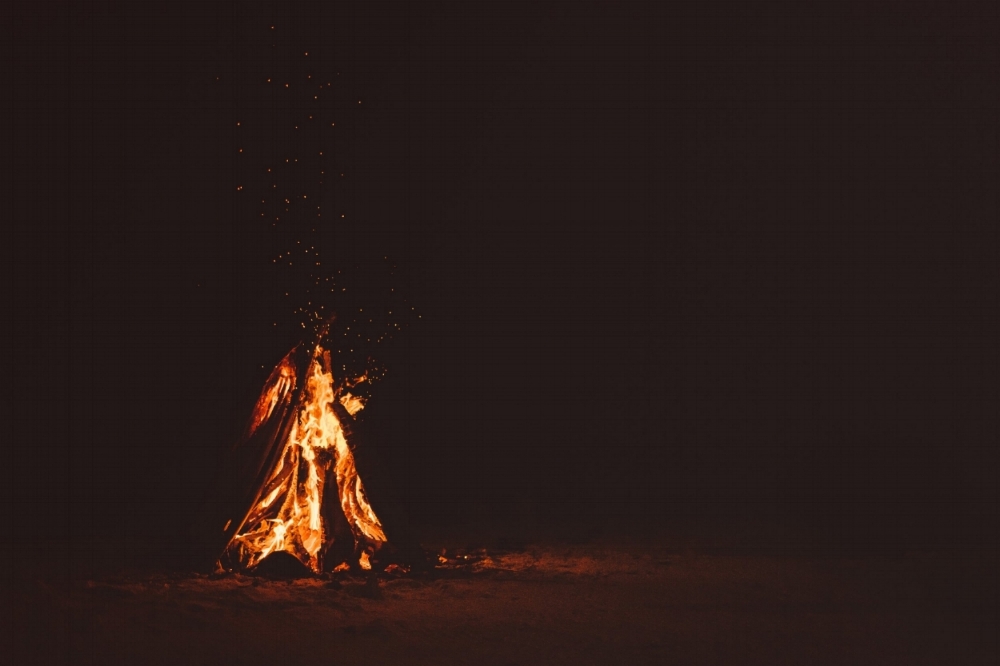
That’s right. Because we’re carrying the fire.
Yes. Because we’re carrying the fire.
This idea of carrying the fire through — and out of — the darkness is a powerful image that will stick with me. The other key element of The Road that left an imprint was its demonstration of the gentle strength of kindness. The wasteland is harsh and unforgiving. Even the smallest moments of kindness — between the father and son or, in broader sense, the rare respite of grace the two encountered — were like shooting stars: a sight to behold and savor.
Shortly after reading The Road, I received an email from two of my mentors — a dynamic husband and wife duo at Carnegie Mellon — sharing Naomi Shihab Nye’s enriching poem, Kindness:
Before you know what kindness really is
you must lose things,
feel the future dissolve in a moment
like salt in a weakened broth.
What you held in your hand,
what you counted and carefully saved,
all this must go so you know
how desolate the landscape can be
between the regions of kindness.
How you ride and ride
thinking the bus will never stop,
the passengers eating maize and chicken
will stare out the window forever.
Before you learn the tender gravity of kindness
you must travel where the Indian in a white poncho
lies dead by the side of the road.
You must see how this could be you,
how he too was someone
who journeyed through the night with plans
and the simple breath that kept him alive.
Before you know kindness as the deepest thing inside,
you must know sorrow as the other deepest thing.
You must wake up with sorrow.
You must speak to it till your voice
catches the thread of all sorrows
and you see the size of the cloth.
Then it is only kindness that makes sense anymore,
only kindness that ties your shoes
and sends you out into the day to gaze at bread,
only kindness that raises its head
from the crowd of the world to say
It is I you have been looking for,
and then goes with you everywhere
like a shadow or a friend.
This poem and The Road are oases in trying times. I plan to route the journey ahead to include retreats to their — and other sanctuaries’s — wisdom. It is one way of many to renew again the fire that we must all carry.
In a beautiful and reflective essay for the Atlantic titled “My President Was Black”, Ta-Nehesi Coates’s critical voice provides some insight for that difficult project. Though Coates colors the essay with an informed pessimism, his study of Obama is helpful. Towards the beginning, Coates begins to excavate Obama’s internal compass of hope:
This assessment [that Trump couldn’t win] was born out of the president’s innate optimism and unwavering faith in the ultimate wisdom of the American people—the same traits that had propelled his unlikely five-year ascent from Illinois state senator to U.S. senator to leader of the free world. The speech that launched his rise, the keynote address at the 2004 Democratic National Convention, emerged right from this logic. He addressed himself to his “fellow Americans, Democrats, Republicans, independents,” all of whom, he insisted, were more united than they had been led to believe.
Coates finds that Obama’s optimism had consequences for his prowess as a leader:
Over the next 12 years, I came to regard Obama as a skilled politician, a deeply moral human being, and one of the greatest presidents in American history. He was phenomenal—the most agile interpreter and navigator of the color line I had ever seen. He had an ability to emote a deep and sincere connection to the hearts of black people, while never doubting the hearts of white people. This was the core of his 2004 keynote, and it marked his historic race speech during the 2008 campaign at Philadelphia’s National Constitution Center—and blinded him to the appeal of Trump. (“As a general proposition, it’s hard to run for president by telling people how terrible things are,” Obama once said to me.)
Because of that skill, Coates poetically notes that “[f]or eight years Barack Obama walked on ice and never fell.”
Coates deftly explores the paradox of hope that Obama had to embrace to be a black president in a deeply unjust country — and how his upbringing uniquely prepared him for the task of “stand[ing] firm in his own cultural traditions and say[ing] to the country something virtually no black person can, but every president must: ‘I believe you.’”
Coates states bluntly where the current state of affairs has left him:
I still want Obama to be right. I still would like to fold myself into the dream. This will not be possible.
Confronted by Trump’s victory, the president, however, held firm:
[H]e said that his general optimism about the shape of American history remained unchanged. “To be optimistic about the long-term trends of the United States doesn’t mean that everything is going to go in a smooth, direct, straight line,” he said. “It goes forward sometimes, sometimes it goes back, sometimes it goes sideways, sometimes it zigs and zags.”
Despite his pessimism, Coates leaves us a triumphant image:
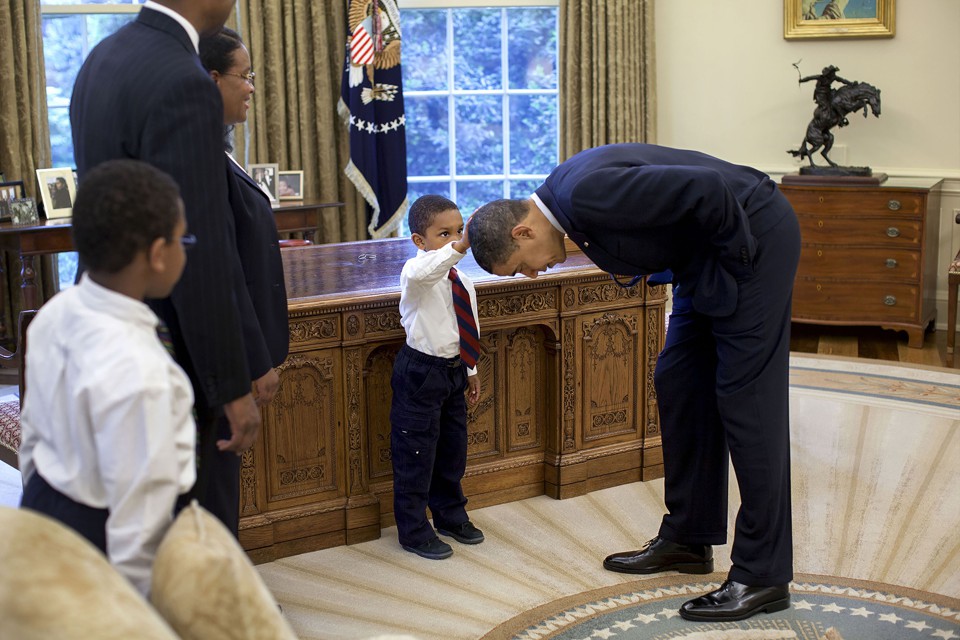
And I also knew that the man who could not countenance [more tragedy and fear] in his America had been responsible for the only time in my life when I felt, as the first lady had once said, proud of my country, and I knew that it was his very lack of countenance, his incredible faith, his improbable trust in his countrymen, that had made that feeling possible. The feeling was that little black boy touching the president’s hair. It was watching Obama on the campaign trail, always expecting the worst and amazed that the worst never happened. It was how I’d felt seeing Barack and Michelle during the inauguration, the car slow-dragging down Pennsylvania Avenue, the crowd cheering, and then the two of them rising up out of the limo, rising up from fear, smiling, waving, defying despair, defying history, defying gravity.
As we transition to the next chapter, we must all take note of Obama’s resilience during his eight years in the White House. Perhaps naively, I still believe in a politics of hope.
Hope is an orientation. Hope is carrying the fire. In the deepest sense, I’m fired up and ready go. The work doesn’t begin now, it has always been before us. An unbroken chain of individuals and communities have carried the fire to this point. We’ll be okay as long as we continue to carry it.
Quisque iaculis facilisis lacinia. Mauris euismod pellentesque tellus sit amet mollis.